Richard Bandler and NLP: How His Work Transformed My Approach to Hypnotherapy
When people ask where my approach to hypnosis comes from, Richard Bandler is one of the first names I mention. His work did not simply hand me techniques. It gave me a different way of thinking about what is possible.
I want to tell you about that, and about a seminar in Germany in 2023 that changed how I work. But I also want to be honest about something that most articles on this subject leave out, so I will come to that first.
An honest note about the evidence
Neuro-Linguistic Programming does not have a strong research base. That is not a controversial statement among people who look at the literature carefully. Systematic reviews have largely failed to support its central claims, and several specific components — the idea that people have a dominant representational system, or that eye movements reveal how someone is thinking — have been tested and have not held up.
I say this plainly because I say it everywhere else on this site, and it would be strange to make an exception for the thing I happen to like.
So why does Bandler's work still sit at the centre of how I practise?
Because what I take from him is not a set of validated interventions. It is a way of paying attention. The belief that people are not broken. The insistence that precise language matters enormously. The orientation toward what someone wants rather than an archaeology of how they came to be stuck. Those are working principles, and they have served me and my clients well. They are not the same thing as clinical proof, and I would not want you to hear them as such.
If someone tells you NLP is scientifically established, they are overstating it. If someone tells you it is therefore worthless, they have not watched a skilled practitioner work.
Who Richard Bandler is
Bandler is an American author and educator, best known as the co-creator of NLP alongside the linguist John Grinder in the 1970s at the University of California, Santa Cruz. He has spent more than five decades teaching methods for rapid personal change to therapists, coaches and communicators around the world. Tony Robbins is among those who have credited Bandler's early influence on their work.
What has always stood out to me is that he is not a theorist. He is a practitioner who cares about whether something worked in the room this afternoon.
His books are worth reading if the subject interests you. Frogs into Princes is where NLP was first laid out. Using Your Brain for a Change is the most practical. The Structure of Magic is the most intellectually serious, and the driest.
The Milton Erickson connection
This is the part that matters most for hypnotherapy specifically.
In the 1970s, Bandler and Grinder studied the therapeutic language of Dr Milton H. Erickson, widely regarded as the most significant hypnotherapist of the twentieth century, and attempted to describe precisely what he was doing. What emerged became known as the Milton Model — a set of hypnotic language patterns using deliberate vagueness, embedded suggestion, metaphor and presupposition to communicate with the subconscious without provoking resistance.
Whatever one thinks of NLP as a whole, this piece of work was genuinely valuable. It demonstrated that hypnotic language is not mysterious. It is a structured, learnable skill.
That insight changed how I write every recording. When I use an indirect suggestion or a carefully built metaphor, I am applying something that runs from Erickson through Bandler to the script in front of me.
Meeting Richard Bandler in 2023: A Practitioner's First-Hand Account
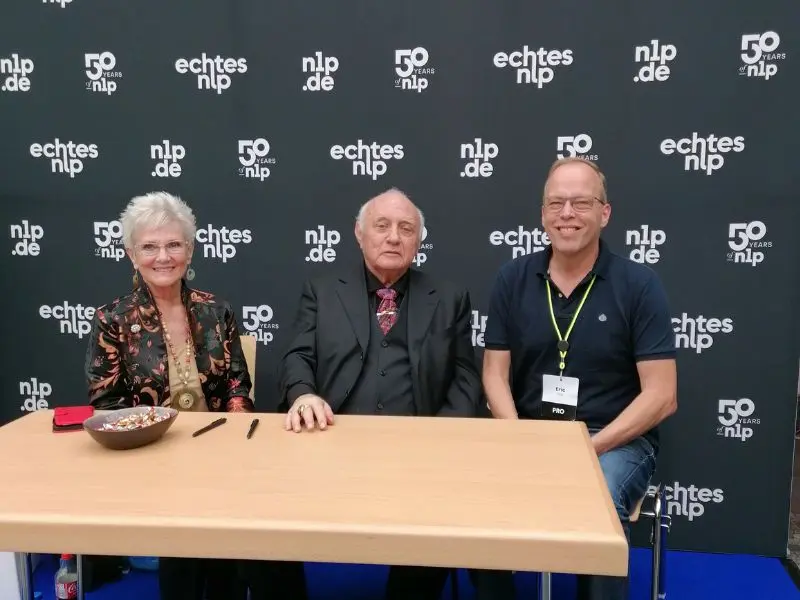
In 2023 I attended a four-day seminar where Bandler was teaching in person. Having studied his books for years, being in the room was a remarkable thing.
What struck me most was the precision underneath what looks like effortless spontaneity.
He would tell what seemed to be a throwaway joke, and three minutes later you would realise it had reoriented the emotional state of the entire room. He would ask a question that sounded simple, and you would watch someone's posture change as an old pattern came apart. Every word, every pause, every shift in tone was there for a reason.
Seeing him work confirmed something I had suspected but never quite trusted: that change can be playful and profound at the same time. It does not have to be heavy or slow or painful. It can happen in a moment of laughter, in a well-placed story, in a question that makes you see something differently.
That seminar gave me permission to be lighter in sessions, to trust the precision of language more, and to hold — as he holds it absolutely — that every person already has what they need.
How this shows up in the recordings
If you have listened to my sessions, you have already heard the influence, whether or not you noticed it.
Language patterns. I use embedded suggestion, metaphor and deliberate ambiguity drawn from the Milton Model. The words are not decoration around the work. They are the mechanism.
Reframing. Most sessions include a moment designed to let you experience a difficulty from a different angle, which loosens the grip of the old meaning.
Anchoring. Specific tones, phrases and pacing recur through a recording so that with repetition those cues begin to bring the calm or focus with them.
Working with imagery. Rather than analysing why a problem exists, I often guide you to change the qualities of the mental images attached to it — smaller, quieter, further away — while brightening the states you want more of.
Forward focus. The approach is oriented toward what comes next rather than toward the origins of the problem.
Three things I took from him
Change can be fast, and it can be enjoyable. It does not have to be solemn to be serious.
Language is the tool, not the packaging. This is why I spend so long on the wording of a script that most listeners will never consciously notice.
Nobody is broken. People already have the resources they need. The work is helping them reach and reorganise what is already there. That belief sits underneath everything I make.
A thank-you
Without Bandler's modelling of Erickson, the language in my recordings would be less precise. Without his books, I might never have seen the structure beneath what looks like natural conversation. Without four days in Germany, I might still be treating transformation as difficult rather than light.
So this is a thank-you — to someone who refused to accept that people are stuck.
If you would like to hear how this works in practice, Freedom from Anxiety and Freedom from Insomnia are good places to begin. The second is free and complete.
Frequently asked questions
Who is Richard Bandler?
An American author and educator, co-creator of Neuro-Linguistic Programming with the linguist John Grinder in the 1970s. He has spent more than five decades teaching methods for rapid personal change and has developed several proprietary systems, including Neuro-Hypnotic Repatterning.
What is NLP, and how does it relate to hypnosis?
NLP is a model of how language, thought and behaviour interact, and how those patterns might be changed. Its connection to hypnosis is direct: much of it emerged from Bandler and Grinder's study of Milton Erickson's hypnotic language, which produced the Milton Model — a structured set of indirect language patterns still widely used in hypnotherapy today. That linguistic work has proved more durable than many of NLP's other claims.
Is NLP scientifically proven?
No, and I would be wary of anyone who says otherwise. Systematic reviews have generally not supported NLP's core claims, and several specific components have been tested and not held up. What I find useful is its practical framing and its language work, particularly the Milton Model. That is a different claim from clinical validation, and I would rather be clear about the difference.
Do I need to know anything about NLP to use your recordings?
Not at all. The techniques operate in the background — in the phrasing, the pacing, the imagery. You only need somewhere comfortable, headphones and about thirty-five minutes.
Where should I start if I am new to this?
Freedom from Insomnia is free and complete, and sleep is usually the easiest thing to shift first. If you would rather understand the mechanics before trying anything, my post on who can be hypnotised answers the questions I hear most often.
Ready to Experience Hypnotherapy?
Explore our collection of guided hypnosis sessions.
Browse Recordings